
Software Development & Strategy
Should an Italian Startup Develop a Native or Hybrid App?
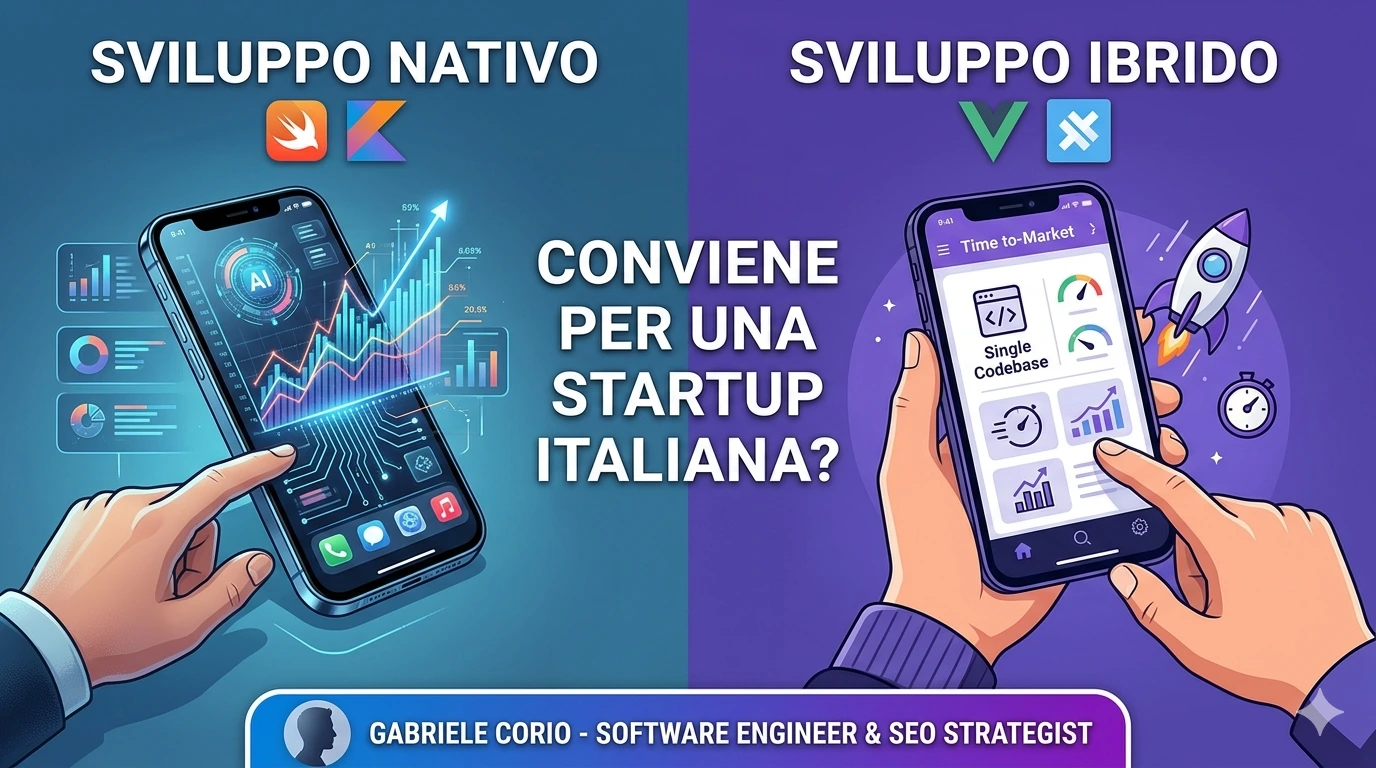
Over the past five years, I have collaborated with more than ten brands. I’ve seen dozens of entrepreneurs face the exact same crossroads. They often come to me with an ambitious idea but a budget that needs to be managed with extreme care. The question they always ask is: should an Italian startup develop a native or hybrid app in today’s market?
There is no one-size-fits-all answer, but there is a strategic one. In my experience as a Software Engineer, I have seen too many startups burn through capital on complex native developments before they even validated their market. What I always tell my clients is: don’t just look at the code—look at the business.
My Technical Analysis: Native vs. Hybrid
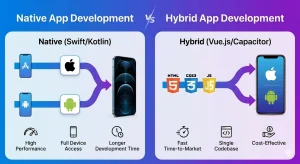
To understand which one to choose, we must look at the data and the 2026 market reality. Native development (using Swift for iOS or Kotlin for Android) offers unbeatable performance and total access to device APIs. However, it requires separate teams and doubles the release time.
On the other hand, hybrid technologies have made massive leaps forward. As shown by current industry trends, a well-optimized hybrid app is now almost indistinguishable from a native one for the end user. For an Italian startup, the primary advantage is Time-to-Market.
Developing a single codebase that works on both platforms allows you to cut maintenance costs in half. Therefore, if your goal is to quickly test your product and scale, hybrid technology is often the winning choice. I have helped many companies launch solid products in record time precisely because of this approach.
Why Scalability is Not Optional
Many developers limit themselves to just making the app “work.” I prefer to talk about total security and modularity. When I design an architecture, whether in Laravel or GoLang, I do it thinking about where it will be two years from now.
There is nothing worse than having to rewrite everything after six months because the app can’t handle the traffic. For this reason, I always integrate advanced cloud infrastructures like those offered by Amazon Web Services (AWS) or Oracle. My approach to Performance Tuning has allowed me to reduce loading times by up to 50% in critical projects. A slow app is an app that loses users, regardless of the technology chosen.
Integrating AI into the Workflow

Today, asking whether an Italian startup should develop a native or hybrid app also means asking how Artificial Intelligence can provide a real competitive edge.
In my work, I don’t just implement LLMs or basic automations. I use AI to make the app “smart” and capable of solving real business problems. Whether it’s predictive analysis or advanced conversational interfaces (leveraging OpenAI APIs), AI must be seamlessly integrated into the workflow. This is what transforms a simple software into a high-value corporate asset.
My Method: Vue.js + Capacitor.js
Over the years, I have refined a stack that I consider unbeatable for startups: Vue.js combined with Capacitor.js.
Why this choice? Because it allows me to offer the flexibility of the web with the performance of the mobile world. Thanks to Capacitor, I can deliver professional-grade products while drastically reducing costs compared to a traditional software house that employs separate teams.
By using this method, I act as a single expert point of contact. I manage everything from the Vue.js frontend to the Python or Go backend, ensuring technical consistency that is hard to find in agencies with too many hand-offs.
Conclusion: My Vision for Your Project
In conclusion, if you are wondering if it is better to develop a native or hybrid app for an Italian startup, my advice is clear. Unless you have extreme graphic processing needs or require low-level hardware manipulation, modern hybrid is the highway to optimizing your budget and validating your idea.
However, technology is just a tool. What matters is how it is implemented to support your business vision. Don’t just choose a programmer; choose a partner who understands your growth and security goals.
Do you have a project in mind or a technical challenge that seems insurmountable? Write to me directly. Let’s discuss your vision and how I can help you transform it into a scalable and successful digital product.